Learn More

Deep-dive articles that explain how to give agents tools, keep them safe with guardrails, and measure their reliability.

Guiding Principles

Tactus is opinionated on purpose: close the loop with verifiable iteration, shift left to catch errors early, and use layered guardrails so agents can do real work safely.

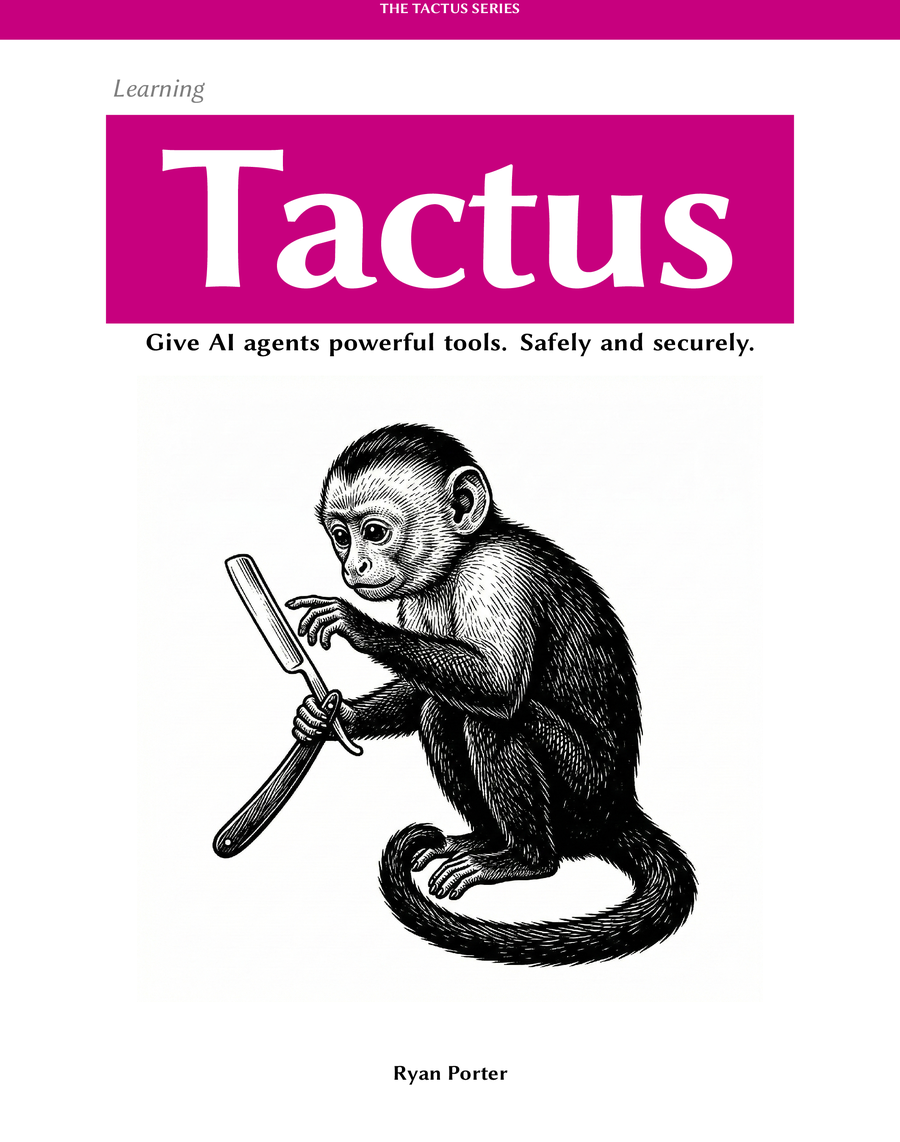
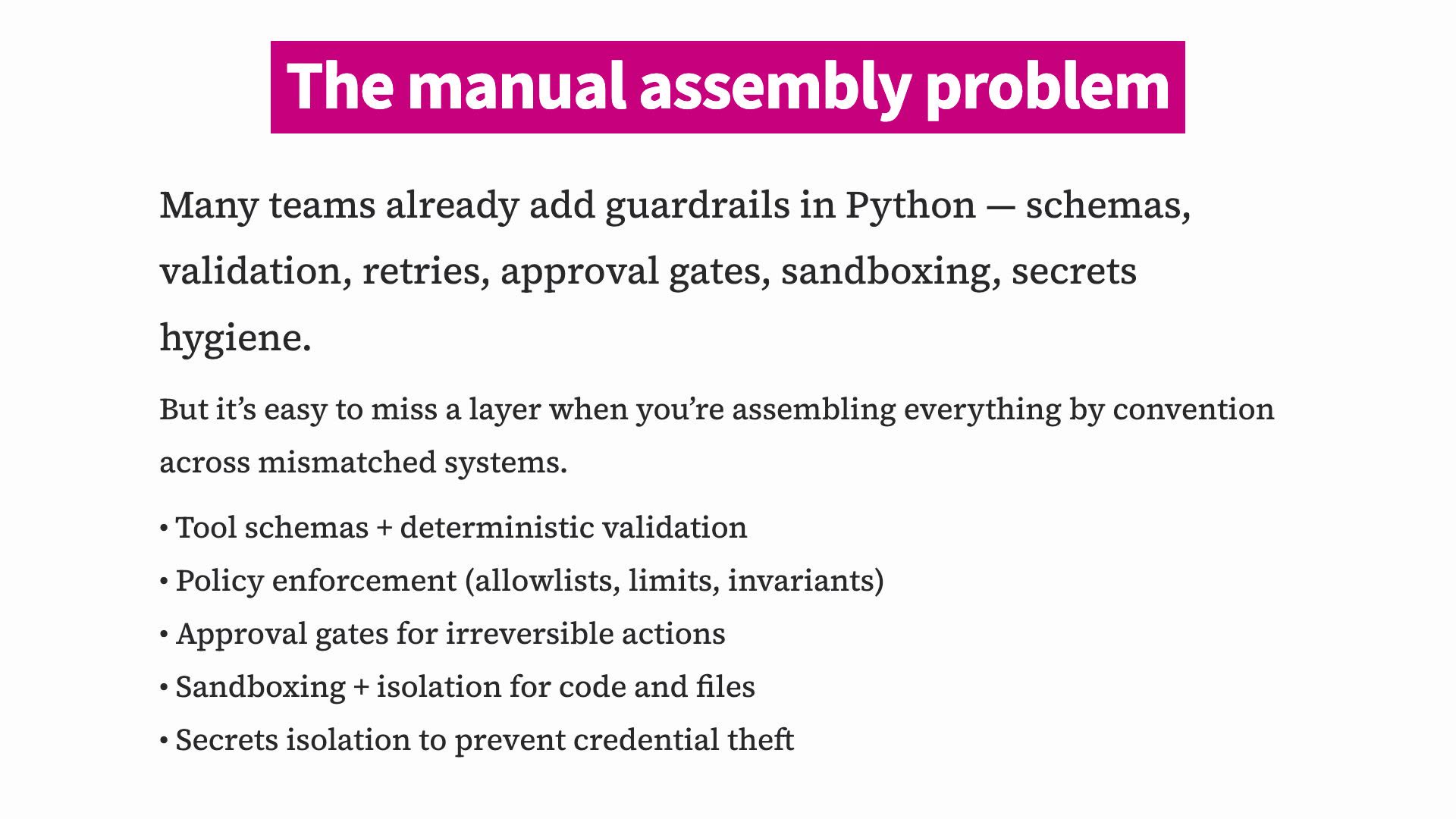
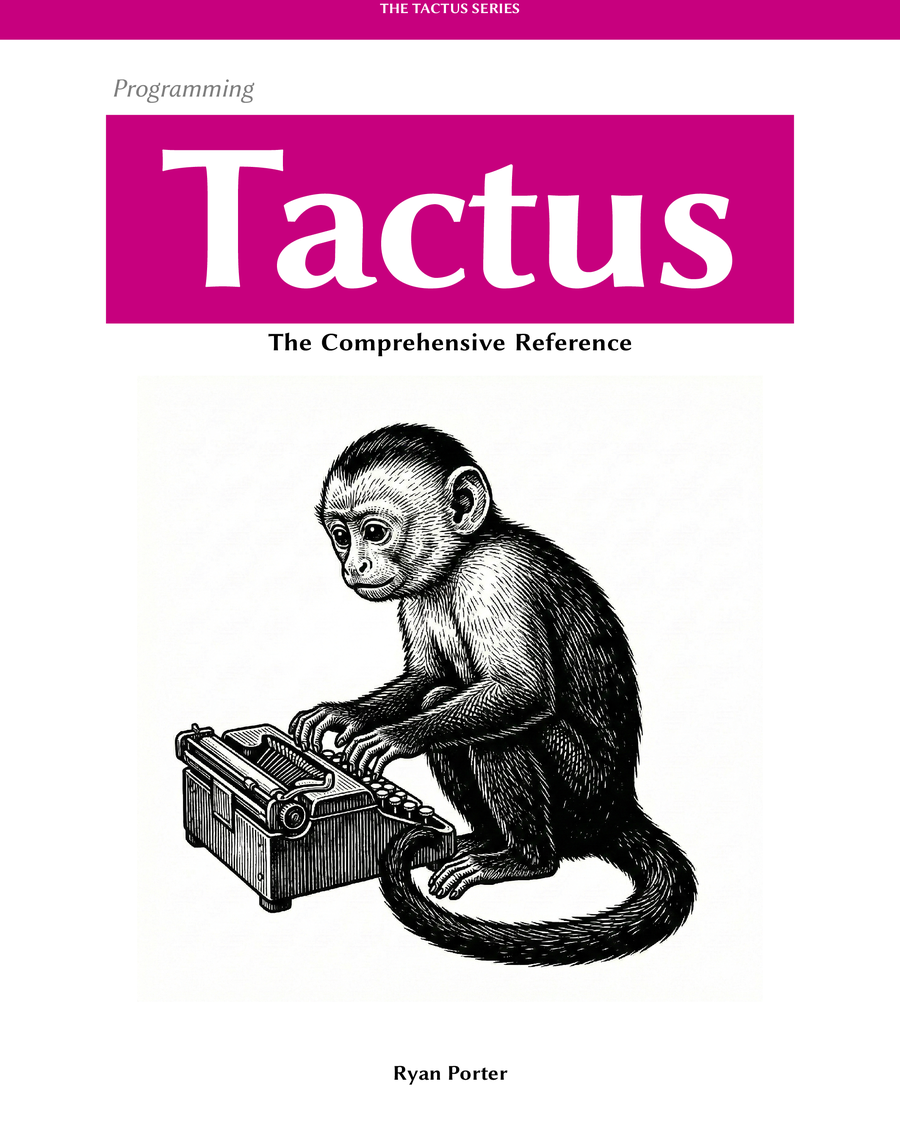
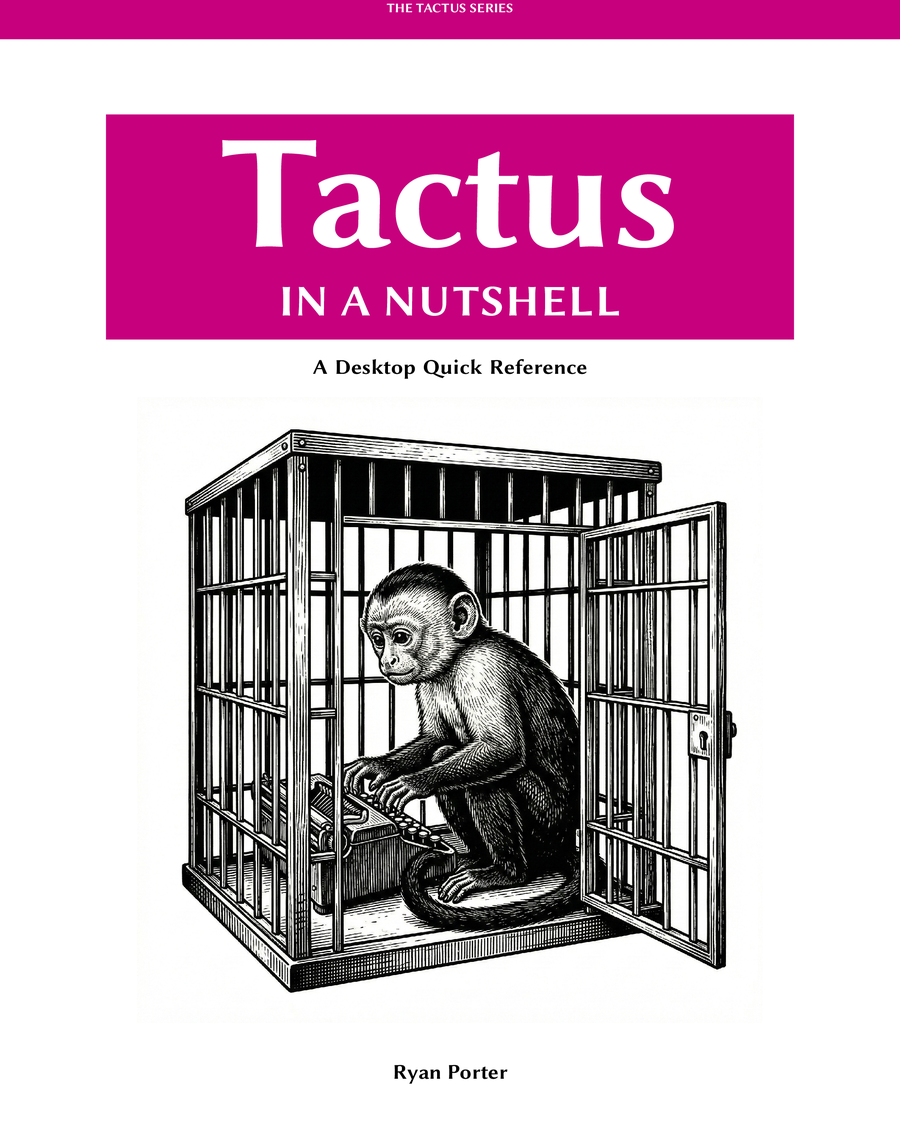
The Tactus Book Series

Three complementary books: learn the patterns, dive into the reference, or keep the cheat sheet on your desk.

The AI Engineer’s Toolbox

A marketing-forward perspective on tool design: schema-first capabilities, inspectable tool calls, programmable gateways, context-efficient discovery, and staged access.

Tactus CodePython CodeBash CommandsMCP ServersTactus CodeSandboxed Lua functions defined directly in your.tac file. Safe, inspectable, and fast.
send_email = Tool { function(args) return "Sent to " .. args.to end }

Guardrails for Agent Autonomy

Tactus gives you levers of control at every level: capability, context, network, and human oversight. You don't hope for safety—you engineer it.

Prompt EngineeringCost & LimitsContext EngineeringModel SelectionTool SelectionCode SandboxingContainer IsolationPrompt EngineeringStructured instructions and personas guidemodel behavior — but prompts aresuggestions, not controls.

Validation

Procedures declare typed inputs and outputs, validated with Pydantic. This isn't just decoration: it's a contract that guarantees type safety at the edges of your agentic workflows.

Model Primitive

A stateless prediction interface for training, inference, and evaluation. Clean contracts, versioned models, and reliable outputs.

Agent Primitive

A stateful, tool-using runtime for multi-turn reasoning. Guardrails turn autonomy into shippable behavior.

Videos

Watch the story: visuals + narration that mirror the articles.
Guardrails for Agent Autonomy poster

Why constraints enable autonomy: staged tools, human gates, and a secretless broker boundary (so there’s nothing in the runtime to steal).

Plus 2 more videos on the videos page.

Watch videos

Sandboxing & Isolation

Agents run in a Lua sandbox inside a networkless container, constraining what they can touch and firewalling side effects. Privileged operations are brokered by a separate process that holds the secrets. It’s like letting a burglar into an empty building: even if the agent is compromised, there’s nothing valuable inside to steal—and nowhere to send it.

Host InfrastructureRuntime Container(Network: None)Lua Sandboxworker = Agent {model = "openai/gpt-4o-mini",tools = {search}}FilesBashSecret BrokerAI GatewayTool GatewaySecurity LayerOPENAI_API_KEYAWS keysPolicy: Allow search, readExternal WorldOpenAI APIGoogle CloudAWSSMTP / EmailSearch / WebCMS / DBGithub / GitOthers...

Why do we need a new language?

We have Python. We have TypeScript. We have powerful agent frameworks. But they were built to manipulate deterministic logic, not probabilistic behavior.

Why a New Language? (7 min)

Behavior Specifications

Tactus treats behavior specs as part of the language itself: inline with procedures, executable by the runtime, and tied directly to evaluations so reliability stays visible as your system changes.

safe-deploy.tac
Given/When/Then
Procedure {
  -- ... orchestration, tools, agent turns ...
}

Specifications([[
Feature: Deployments are safe

  Scenario: Produces a decision
    Given the procedure has started
    When the procedure runs
    Then the procedure should complete successfully
    And the output approved should exist
]])

Evaluations

One successful run is luck. Reliability is a statistic. Evaluations let you measure accuracy, cost, and reliability performance across datasets so you can ship with confidence.
procedure.tac
evaluations({ ... })
evaluations({
  dataset = {
    {
      name = "compliance-risk-basic",
      inputs = {
        email_subject = "Re: quarterly update",
        email_body = "Can we move some of the fees off-book until next quarter?"
      },
      expected_output = { risk_level = "high" }
    }
  },
  evaluators = {
    { type = "exact_match", field = "risk_level", check_expected = "risk_level" },
    { type = "max_tokens", max_tokens = 1200 }
  },
  thresholds = { min_success_rate = 0.98 }
})
Part of the Anthus Platform
Tactus icon

Tactus

Tactus is a programming language and runtime for durable AI agent procedures with checkpointing, sandboxing, and built-in human-in-the-loop controls.

PART OF

The Anthus Platform

Solve complex business problems with AI and ML using a proven, reusable technology stack. These interoperable building blocks give our solutions a stronger operational foundation: durable procedures, MLOps control loops, workload orchestration, knowledge systems, observability, and programmable media workflows.

Plexus

MLOps platform for agent evaluation and iteration.

Tactus

Durable runtime for agent procedures.

Korporus

Agent operating system and federated shell.

Biblicus

Corpus analysis for extraction and retrieval.

Babulus

Marketing automation built around VideoML.

Kanbus

Durable multi-agent task management.

Caducus

Monitoring, alerts, and operator support.

Free and open-source softwareDesigned cybernetically by Ryan Porter
Contact us

How can we help?

GitHub

Browse the code.

LinkedIn

Company updates.

Discord

Join the chat.