Learning Tactus
A coherent introduction: the why, the mental model, and the core patterns.
Deep-dive articles that explain how to give agents tools, keep them safe with guardrails, and measure their reliability.
Tactus is opinionated on purpose: close the loop with verifiable iteration, shift left to catch errors early, and use layered guardrails so agents can do real work safely.
Three complementary books: learn the patterns, dive into the reference, or keep the cheat sheet on your desk.
A marketing-forward perspective on tool design: schema-first capabilities, inspectable tool calls, deterministic orchestration, and staged access.
Tactus gives you levers of control at every level: capability, context, network, and human oversight. You don't hope for safety—you engineer it.
Procedures declare typed inputs and outputs, validated with Pydantic. This isn't just decoration: it's a contract that guarantees type safety at the edges of your agentic workflows.
A stateless prediction interface for training, inference, and evaluation. Clean contracts, versioned models, and reliable outputs.
A stateful, tool-using runtime for multi-turn reasoning. Guardrails turn autonomy into shippable behavior.
Watch the story: visuals + narration that mirror the articles.
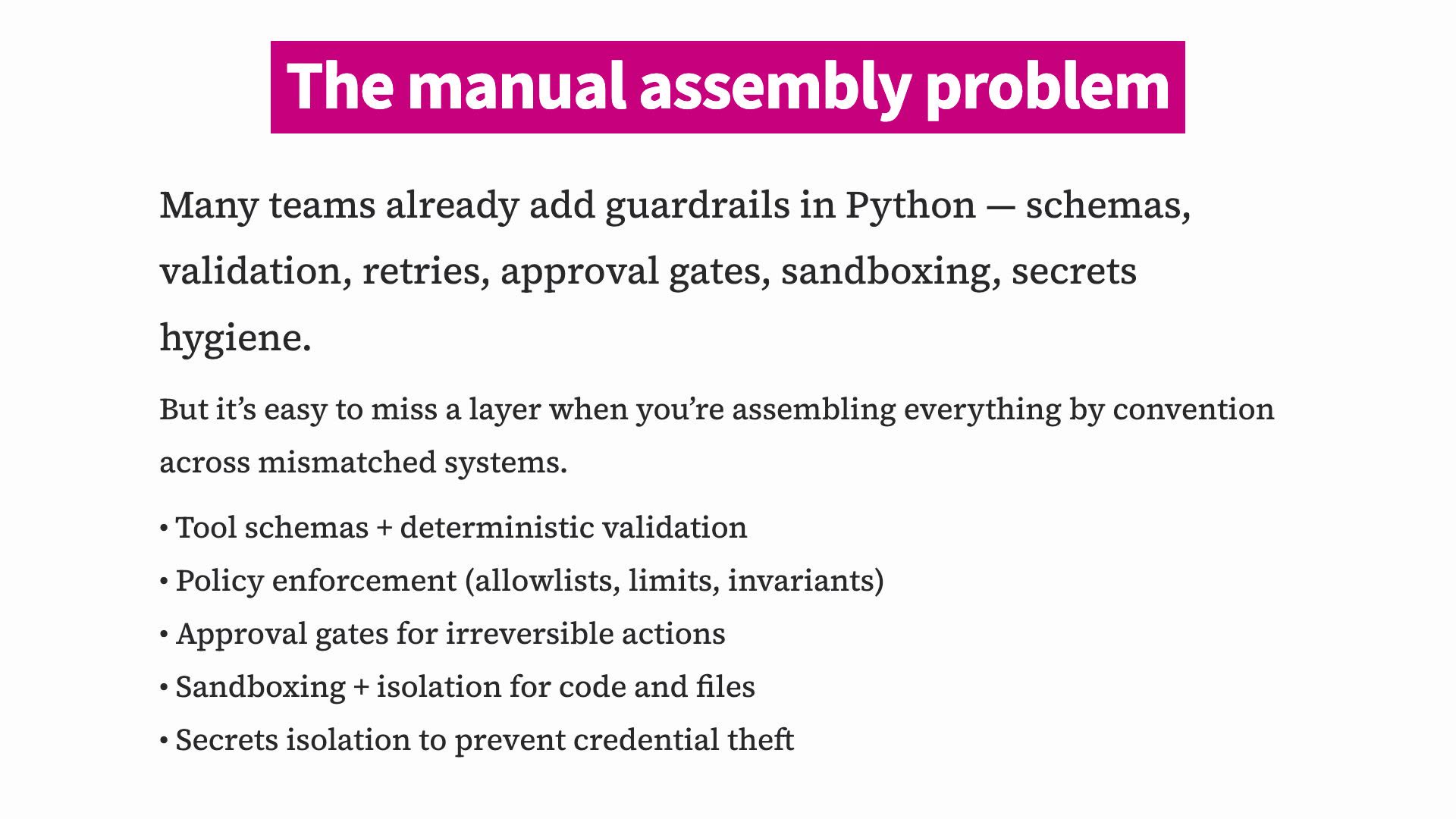
Why constraints enable autonomy: staged tools, human gates, and a secretless broker boundary (so there’s nothing in the runtime to steal).
Agents run in a Lua sandbox inside a networkless container, constraining what they can touch and firewalling side effects. Privileged operations are brokered by a separate process that holds the secrets. It’s like letting a burglar into an empty building: even if the agent is compromised, there’s nothing valuable inside to steal—and nowhere to send it.
We have Python. We have TypeScript. We have powerful agent frameworks. But they were built to manipulate deterministic logic, not probabilistic behavior.
Tactus treats behavior specs as part of the language itself: inline with procedures, executable by the runtime, and tied directly to evaluations so reliability stays visible as your system changes.
One successful run is luck. Reliability is a statistic. Evaluations let you measure accuracy, cost, and reliability performance across datasets so you can ship with confidence.